What Is Adaptive Software Development? A Complete Guide
Software projects rarely finish exactly the way they were imagined on day one. A customer changes priorities. Users dislike a feature everyone thought they wanted. A competitor launches something new. A technical limitation appears halfway through development. Regulations change. A new technology suddenly makes the original solution look outdated.
Traditional project plans often treat these changes as problems. Adaptive Software Development treats them as normal.
Adaptive Software Development, usually shortened to ASD, is an iterative software development approach designed for projects where requirements, technology, and priorities are expected to change. Instead of trying to predict every detail before development starts, teams work in short cycles, build useful features, collaborate closely, learn from what happens, and adjust the next cycle.
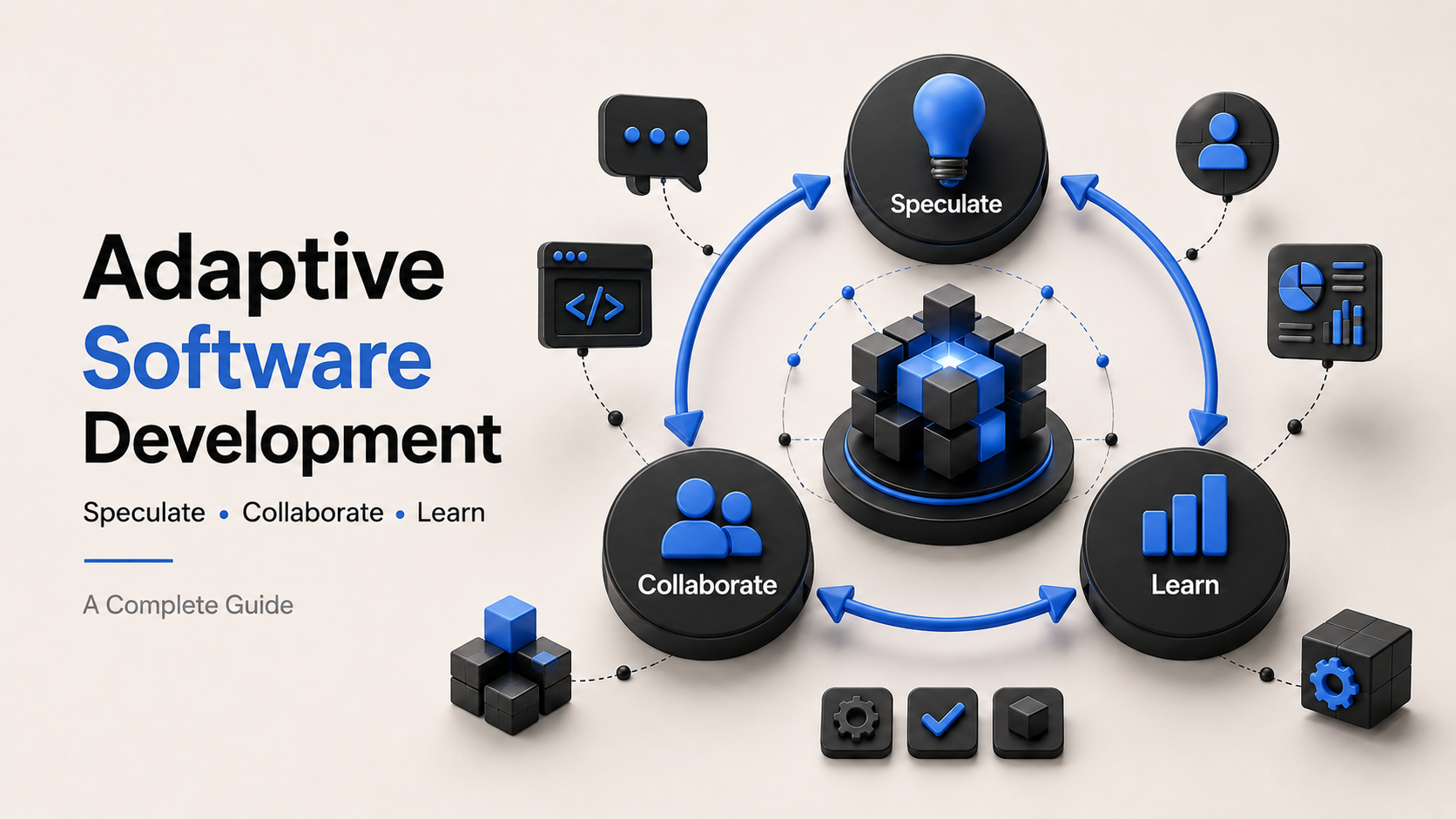
The entire methodology revolves around three repeating stages: Speculate → Collaborate → Learn. The idea grew from the work of Jim Highsmith and Sam Bayer and evolved from Rapid Application Development practices. Highsmith later formalized the approach in his book Adaptive Software Development: A Collaborative Approach to Managing Complex Systems.
This guide explains how Adaptive Software Development works, how it compares with Agile, Scrum, and Waterfall, where it works best, its advantages and limitations, and how development teams can actually use it.
What Is Adaptive Software Development?
Adaptive Software Development is built around one basic idea: you cannot predict everything about a complex software project before you start building it. Instead of creating one detailed plan and trying to follow it until launch, ASD assumes that understanding will improve as the project progresses.
Teams create an initial direction, build part of the product, gather information, learn from users and technical results, and then adjust what happens next. Plans still exist, but they are treated as flexible assumptions rather than fixed commitments.
A traditional project might say: we know exactly what we are building, how long each part will take, and what the final product should look like. An adaptive project says: we know the problem we want to solve and the direction we want to take. We will improve the solution as we learn more. That does not mean ASD has no planning it means planning is expected to change.
Where Did Adaptive Software Development Come From?
ASD grew from work Jim Highsmith and Sam Bayer were doing with Rapid Application Development (RAD) during the 1990s. RAD had already challenged slower models by encouraging faster iterations and more user involvement. ASD pushed that thinking further.
Highsmith argued that complex software projects behave more like changing systems than predictable manufacturing processes. Instead of trying to eliminate uncertainty, software teams should become better at working with it. He publicly discussed ASD by 1997, and his 2000 book developed the methodology in greater detail.
ASD also became part of the broader movement toward Agile software development. Iterative development, close stakeholder collaboration, continuous feedback, and responding to change fit naturally with ASD thinking.
The Core Idea Behind ASD
Traditional software planning often follows Plan → Build → Test → Deliver, assuming planning happens first and execution follows. ASD uses Speculate → Collaborate → Learn, then repeats.
The word speculate is deliberate. ASD does not pretend an early project plan is guaranteed to be correct. The team makes the best decisions it can using current information, builds something, observes the results, and uses what it learns to improve the next plan. Each cycle should leave the team with both better software and better knowledge.
The Three Phases of Adaptive Software Development
1. Speculate
Most methodologies would call this planning. ASD calls it speculation because the team recognizes that some assumptions will change. The team still creates direction and may define the product mission, business goals, main user problems, important features, project constraints, technical risks, initial priorities, release expectations, and iteration length. The resulting plan is not treated as permanent.
Imagine a company building a new appointment booking platform. During Speculate, the team might decide the first version needs user registration, provider profiles, appointment search, booking, payments, and notifications. Instead of defining every screen and business rule for the next twelve months, the team identifies what needs to be learned first and chooses a manageable set of features for the next cycle.
2. Collaborate
Once the direction is clear, the team works together to build the software. ASD collaboration goes beyond developers dividing tickets. Complex software often requires developers, designers, product managers, QA engineers, business stakeholders, domain experts, customers, and operations teams. No single person understands every part of the problem.
While developers implement the booking system, designers may discover usability problems, customers may request different appointment filters, and developers may uncover payment-provider limitations. Instead of waiting until the entire project is finished, those discoveries can affect the current or next cycle. The goal is shared problem solving, not simply communication.
3. Learn
The Learn phase is what makes the process truly adaptive. After building a software increment, the team examines what happened: Did users understand the feature? Did it solve the expected problem? What assumptions were wrong? What technical problems appeared? Did development take longer than expected? What feedback did customers provide? Did priorities change? What should we do differently next time?
- User feedback users interact with prototypes or working software and explain what works and what does not.
- Testing functional, performance, security, and usability testing reveal weaknesses.
- Analytics real usage data may show whether customers actually use the features the team expected.
- Technical reviews developers may discover architecture problems, technical debt, or better approaches.
- Team retrospectives the team reviews its own process and identifies ways to work more effectively.
The information from this phase feeds directly into the next Speculate phase. That is how the product keeps adapting.
Six Characteristics of Adaptive Software Development
ASD is commonly described through six lifecycle characteristics that help keep an adaptive project from becoming uncontrolled.
- Mission focused features may change, but a clear mission remains the reference point for decisions.
- Feature based teams create working pieces of functionality instead of completing large technical layers in isolation.
- Iterative the product develops through repeated cycles that add functionality and generate new information.
- Timeboxed limited durations force the team to focus on what can realistically be learned or delivered in the cycle.
- Risk driven high uncertainty and high risk should receive attention early, such as testing an experimental AI capability before polishing a settings page.
- Change tolerant a changing requirement is not automatically considered a planning failure; the question becomes how the project should respond.
Adaptive Software Development vs Waterfall
| Area | ASD vs Waterfall |
|---|---|
| Planning | ASD: flexible and revised continuously. Waterfall: defined heavily at the beginning. |
| Requirements | ASD: expected to evolve. Waterfall: expected to be defined early. |
| Development | ASD: iterative. Waterfall: sequential. |
| Customer feedback | ASD: continuous. Waterfall: often concentrated around major stages. |
| Change | ASD: expected. Waterfall: can be expensive or disruptive. |
| Delivery | ASD: incremental. Waterfall: often large staged releases. |
| Best suited for | ASD: uncertain and changing projects. Waterfall: stable and predictable projects. |
Waterfall is not automatically bad. If the scope is highly predictable and change is unlikely, detailed upfront planning can work well. ASD becomes valuable when uncertainty is part of the project itself.
Adaptive Software Development vs Agile and Scrum
ASD and Agile are closely related, but they are not exactly the same. Agile is a broader philosophy and family of approaches. ASD is a specific adaptive methodology with its own Speculate, Collaborate, Learn lifecycle. Both emphasize iterative development, customer feedback, collaboration, responding to change, and incremental delivery. ASD places particularly strong emphasis on uncertainty, learning, and adaptation.
| Area | ASD vs Scrum |
|---|---|
| Core cycle | ASD: Speculate, Collaborate, Learn. Scrum: plan sprint, execute, review, retrospect. |
| Structure | ASD: flexible. Scrum: more defined roles, events, and sprint structures. |
| Roles | ASD: no strict required role structure. Scrum: Product Owner, Scrum Master, Developers. |
| Main emphasis | ASD: adaptation and learning. Scrum: incremental product delivery. |
| Best fit | ASD: high uncertainty. Scrum: broad range of iterative product development. |
A team does not necessarily need to choose only one. A company may use Scrum ceremonies while applying ASD thinking to planning and learning. Similarly, a product team might use a Kanban board for daily work while still following adaptive principles when deciding what should be built next.
A Simple ASD Example
Imagine a startup building an AI tool that helps companies answer customer support questions. The founders believe customers want completely automated support.
- First Speculate build knowledge base upload, AI answer generation, customer chat, and basic analytics, expecting companies to let the AI answer customers automatically.
- Collaborate developers build the first version, designers test the interface, support managers review prototypes, and QA tests AI responses.
- Learn companies like the AI responses but do not trust the system enough to send them directly to customers. They want employees to review responses first.
- Second Speculate the next cycle focuses on AI-generated draft responses, human approval, editing, and feedback collection.
A traditional team might continue building the planned automation because it was already in the roadmap. An adaptive team changes direction because it learned something important. That is ASD in practice.
When Should You Use Adaptive Software Development?
ASD works best when uncertainty is high changing requirements, evolving customer needs, and high technical uncertainty.
- Startups that change product direction as they learn what customers actually want.
- AI and machine learning products involving experimentation with models and data.
- New digital products the business has never built before.
- SaaS platforms that evolve based on usage data, customer requests, and competition.
- Complex enterprise software involving many departments and stakeholders.
- Research and innovation projects where part of the work is discovering whether something is technically possible.
When ASD May Not Be the Best Choice
- Requirements are extremely stable and the solution is already well understood.
- The project is very small.
- Strong fixed regulatory specifications leave little room for product experimentation.
- Stakeholders cannot participate regularly.
- The organization requires highly rigid contractual scope.
A simple website with five predefined pages probably does not require a sophisticated adaptive process. The methodology becomes more valuable as uncertainty increases.
Benefits of Adaptive Software Development
- Better response to change the process already expects adjustment when customer needs or market conditions shift.
- Earlier feedback users and stakeholders see working software sooner.
- Lower product risk short iterations make it cheaper to discover a bad idea after three weeks than after twelve months.
- Better collaboration developers, product teams, customers, and designers solve problems together.
- Continuous improvement the Learn phase can improve development practices, testing, communication, architecture, and workflows.
- Better fit for innovation teams can experiment without treating every change of direction as failure.
Challenges of Adaptive Software Development
- Scope can keep changing if every new idea becomes a priority adaptation still needs a clear mission and prioritization.
- Stakeholders need to participate regularly or learning becomes difficult.
- Budgeting can be harder when executives want an exact answer for the entire project cost months in advance.
- Teams need strong communication; poorly coordinated teams can struggle with intensive collaboration.
- Too much flexibility can become chaos without a mission, priorities, timeboxes, quality standards, and technical discipline.
How to Implement Adaptive Software Development
You do not need to redesign the entire engineering organization overnight. Start with the project.
- Define the mission a clear statement of the problem the product should solve, stable enough to guide decisions when features change.
- Identify the biggest assumptions what customers want, what technical assumptions you are making, what could make the project fail, and what you know least about.
- Build a flexible feature list that separates high-priority needs from items that still need validation.
- Choose a short development cycle one-week, two-week, or similar timeboxes depending on your workflow.
- Collaborate during development avoid long handoffs and surface major problems as soon as they appear.
- Deliver something testable each cycle working functionality, a prototype, an API, a technical proof of concept, or a tested workflow.
- Gather evidence from user interviews, analytics, test results, performance data, conversion rates, support requests, and technical findings.
- Review what you expected, what actually happened, and what should change next then begin the next Speculate phase.
How ASD Fits With Modern DevOps
ASD helps teams decide what to change next. DevOps helps teams build, test, deploy, and operate those changes quickly and reliably. Continuous integration, automated testing, continuous delivery, monitoring, feature flags, and fast deployments can shorten the time between building something and learning whether it works.
What Should an Adaptive Team Measure?
- Customer adoption and feature usage
- Customer satisfaction and business outcomes
- Defect rates, cycle time, and release frequency
- Performance and failed assumptions discovered
- Customer problems solved
Completing twenty tickets means very little if the product is moving in the wrong direction.
Common ASD Mistakes
- Treating speculation as no planning plans are still required, but remain open to revision.
- Changing direction every day based on random ideas instead of meaningful new information.
- Skipping the Learn phase and starting the next iteration without reviewing feedback and results.
- Collecting feedback but ignoring it because the roadmap cannot change.
- Losing the product mission while features and priorities shift.
- Using ASD to avoid commitments, goals, budgets, or accountability.
Is Adaptive Software Development Still Relevant?
Yes. Many teams may not explicitly call their process ASD, but modern software development commonly uses short cycles, continuous customer feedback, iterative releases, Agile product management, experimentation, DevOps, continuous delivery, product analytics, and retrospectives.
ASD's central idea remains highly relevant because software development has become more dynamic, not less. Products compete in markets where customer expectations, AI capabilities, cloud platforms, regulations, and competitors can change quickly. The ability to learn and adjust matters even when a team officially calls its methodology Scrum, Kanban, Agile, or something else.
Where to Go From Here
Adaptive Software Development starts with a simple acceptance: your first plan probably will not be your final plan. That is not necessarily a problem. The mistake is assuming new information will never appear.
ASD gives teams a structured way to handle uncertainty through Speculate, Collaborate, and Learn. Define a direction. Build something useful. Work closely with the people who understand the problem. See what happens. Learn from it. Then improve the next decision.
For predictable projects, a simpler process may be enough. For complex products, startups, AI systems, SaaS platforms, and projects where requirements are still evolving, adaptive development can help teams avoid spending months perfectly executing the wrong plan. Organizations building this kind of product can also combine adaptive practices with modern Agile, DevOps, testing, and continuous delivery through professional software development services. The goal is not to remove planning. It is to create a development process that becomes smarter every time the team learns something new.
Frequently Asked Questions
What is Adaptive Software Development?
Adaptive Software Development is an iterative methodology designed for projects with uncertainty and changing requirements. It uses a repeating cycle of Speculate, Collaborate, and Learn instead of relying on one fixed project plan.
Who created Adaptive Software Development?
ASD grew from the work of Jim Highsmith and Sam Bayer on Rapid Application Development. Highsmith later formalized the approach in Adaptive Software Development: A Collaborative Approach to Managing Complex Systems.
What are the three phases of ASD?
The three phases are Speculate, Collaborate, and Learn. Teams create an adaptive plan, work together to develop an increment, evaluate the results, and use what they learned to guide the next cycle.
Is Adaptive Software Development the same as Agile?
No. Agile is a broader philosophy and family of development approaches. ASD is a specific methodology that shares many Agile principles, particularly iterative development, collaboration, feedback, and responsiveness to change.
What is the difference between ASD and Scrum?
Scrum provides defined roles, events, and sprint structures. ASD is less prescriptive and focuses more strongly on adapting to uncertainty through its Speculate, Collaborate, Learn lifecycle. Teams can also apply adaptive thinking while using Scrum practices.
What projects are best suited for ASD?
ASD works particularly well for projects with changing requirements, new technologies, uncertain customer needs, technical risk, or significant innovation. Startups, SaaS products, AI systems, and complex enterprise applications are common examples.
What is the biggest advantage of Adaptive Software Development?
Its biggest advantage is the ability to respond to new information without treating every change as a project failure. Teams continuously learn from development, customers, testing, and real product usage, then adjust the product accordingly.
What is the biggest risk of ASD?
Without a clear mission, strong prioritization, and disciplined collaboration, flexibility can turn into uncontrolled scope changes. Successful adaptive teams remain flexible about the solution while staying focused on the business problem they are trying to solve.
Ready to estimate your app cost?
Use our free calculator to get a personalised cost breakdown in 2 minutes.
Calculate Your App Cost